How Consultants Can Automate Research with AI
- Philip Curtis
- Apr 9
- 3 min read

Consultants spend a large part of their time gathering information, comparing sources, and turning raw data into useful recommendations. That work is important, but it is also time-consuming and often repetitive.
AI gives consultants a better way. When used correctly, AI can automate research into a repeatable workflow that produces the same type of report every time, while only the underlying data changes. That means faster delivery, more consistency, and more value for clients.

For small and medium-sized businesses, this is especially useful. It helps them get reliable insight without long delays or unnecessary complexity.
Why AI Research Automation Matters for Consultants
Research is one of the biggest bottlenecks in consulting. Whether the work involves market analysis, competitive research, internal assessments, or opportunity identification, the process often starts from scratch each time.
AI can help remove that bottleneck by:
speeding up information gathering,
standardizing analysis,
reducing manual effort,
and making reports more consistent.
The goal is not to replace consultant judgment. The goal is to remove repetitive work so consultants can focus on strategy, recommendations, and client relationships.
From One-Off Prompts to Repeatable Systems
Many people first use AI as a prompt-and-response tool. That works for simple tasks, but it is not the best approach for professional consulting work.
A better approach is to build a repeatable system.
That system should include:
a fixed report structure,
standardized input questions,
clear evaluation criteria,
trusted source material,
and a consistent output format.
When those elements are in place, the report becomes repeatable. The consultant is no longer depending on how a prompt is worded on a given day. Instead, they are using a defined process that generates the same style of output every time.
How to Automate Research with AI
A practical AI research workflow usually follows five steps.
1. Define the report format
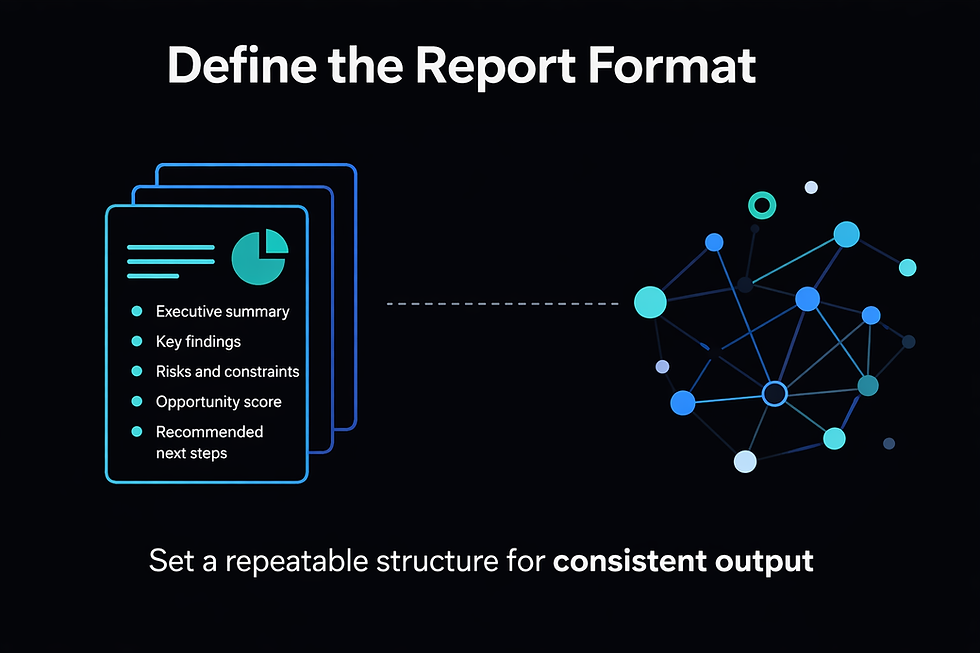
Start by deciding what the final report should look like. This includes sections, headings, scoring methods, and the type of conclusions you want to produce.
For example, a research report might always include:
Executive summary
Key findings
Risks and constraints
Opportunity score
Recommended next steps
This keeps the output stable and easy to reuse.
2. Standardize the input
Instead of relying on a freeform prompt, collect information through a form, spreadsheet, questionnaire, or structured client brief.
The more structured the input, the more consistent the output.
3. Ground the research in data
AI should not invent facts. It should pull from approved sources such as websites, documents, databases, internal notes, or client-provided materials.
This makes the final report more trustworthy and easier to validate.
4. Apply consistent analysis rules
The same framework should be used every time. For example, the AI can always evaluate:
urgency,
market potential,
feasibility,
risk,
and strategic fit.
This is what makes the workflow repeatable. The data changes, but the logic stays the same.
5. Review and refine the final output

A human review step should always remain in place. AI can assemble the report quickly, but consultants should still validate the quality, confirm the recommendations, and adjust the final wording when needed.
That combination of automation and human judgment is what makes the process both efficient and dependable.
Why This Is Valuable for SMBs
Small and medium-sized businesses usually do not have time for long research cycles. They need practical answers quickly.
AI-powered research automation helps SMBs:
make decisions faster,
reduce manual work,
improve consistency,
and get clearer recommendations.
For SMB decision-makers, the value of AI is not novelty. It is speed, clarity, and usefulness.
The Benefit of Repeatable AI Reports

The biggest advantage of a repeatable AI research workflow is consistency.
A well-designed process produces the same report structure every time, even when the underlying data changes. That is important because it allows consultants to:
compare results across clients,
improve efficiency,
scale services,
and build a stronger delivery process.
It also helps clients know what to expect. A predictable report format builds trust and makes the consulting experience feel more professional.
Practical Ways to Implement This
You do not need a complex platform to start. A simple implementation can begin with:
a standard intake form,
a research template,
a source list,
a scoring framework,
and a review process.
Over time, these pieces can be connected into a more advanced workflow using automation tools, AI assistants, and document generation systems.
The most important thing is to start with structure. Once the process is structured, AI can make it much faster and more scalable.
Final Thoughts
Consultants who learn how to automate research with AI will be able to deliver faster, more consistent, and more scalable services.
For SMBs, that means better insight without unnecessary cost or delay.

If your business wants to find practical AI opportunities that create real value, start with our Free AI Opportunity Scan at https://www.aiconsultedge.ai.
It is a simple way to identify where AI can improve research, reduce bottlenecks, and support better decisions.

Comments